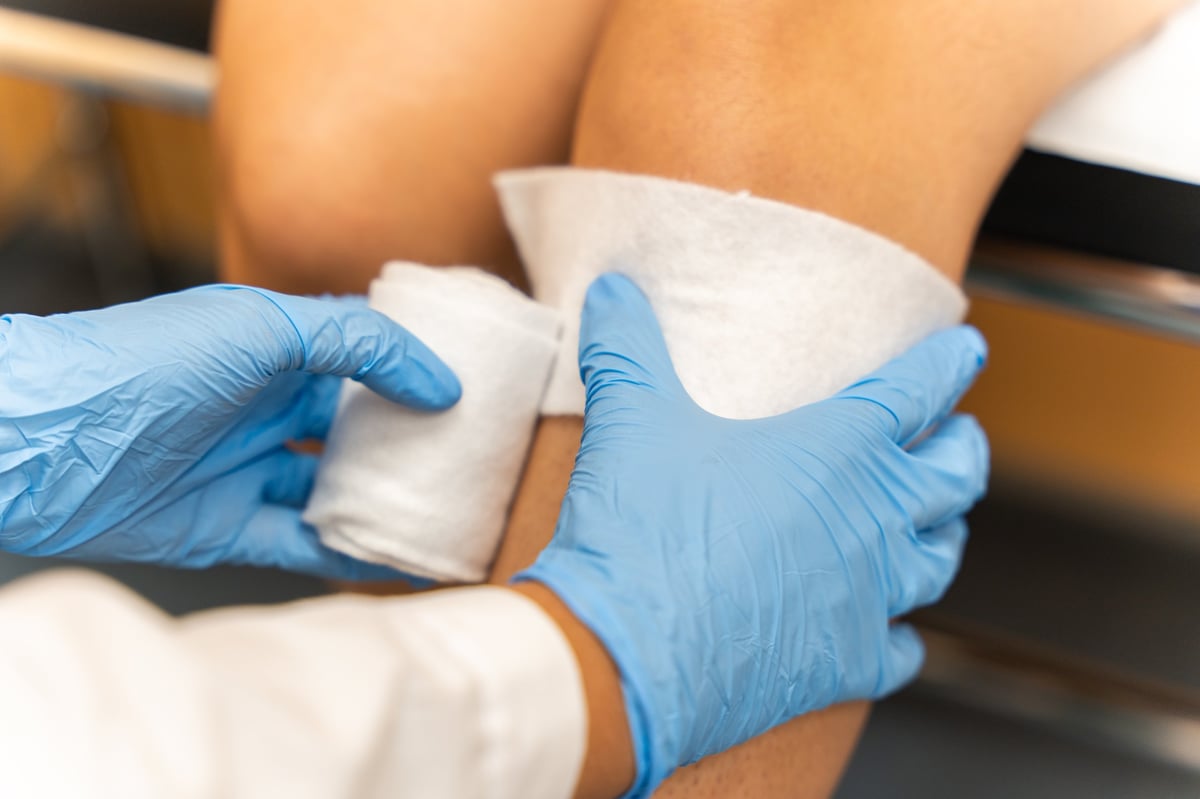
How HBOT Accelerates Healing at the Cellular Level — and Why Millions of Patients Still Can't Access It
6.5 million Americans live with chronic wounds. HBOT is FDA-cleared, Medicare-covered, and clinically proven — yet fewer than 1,400 facilities offer it nationwide. Here's what patients and clinicians need to know.
June 17, 2026
6.5M+
Americans with chronic wounds that resist standard treatment
$9B+
Annual cost of diabetic foot ulcers — direct healthcare spend in the US alone
14K+
Monthly HBOT wound searches — patients and clinicians actively researching
A wound that will not heal is not just a medical problem — it is a life problem. For the 6.5 million Americans living with chronic wounds, each day brings pain, immobility, infection risk, and the very real possibility of amputation. For many of these patients, standard wound care — debridement, dressings, antibiotics, offloading — has reached its limit. Something is missing. That something, in most cases, is oxygen.
Hyperbaric oxygen therapy is the only treatment modality that addresses wound healing at the cellular level by delivering oxygen directly to the compromised tissue that needs it most. It is FDA-cleared, Medicare-covered, and supported by decades of clinical evidence — yet access remains limited to fewer than 1,400 facilities nationwide. This guide explains how HBOT works for wound healing, which wounds it treats, and how to access it through a physician.
Normal wound healing is an oxygen-dependent process. From the moment of injury, the body mobilizes a cascade of biological responses — inflammation, new blood vessel formation, collagen synthesis, tissue remodeling — all of which require a continuous, adequate oxygen supply to proceed correctly.
Chronic wounds fail to heal because this oxygen supply is disrupted. The most common causes are:
In each of these scenarios, the fundamental problem is the same: the tissue that needs to heal is not receiving enough oxygen to do so. HBOT addresses this at its source.
Inside a pressurized hyperbaric chamber, a patient breathes pure oxygen at two to three times normal atmospheric pressure. This forces oxygen to dissolve directly into blood plasma — the liquid component of blood — at concentrations far exceeding what red blood cells alone can deliver. That oxygen-rich plasma reaches wound tissue through whatever circulation remains, even in severely compromised vascular beds.
The cascade of healing responses that HBOT triggers includes:
The growth of new blood vessels directly into oxygen-deprived wound tissue, restoring the circulation that healing depends on — and sustaining that improved circulation long after treatment ends.
White blood cells destroy bacteria by oxidative burst; HBOT provides the oxygen concentration this process requires, dramatically improving the body's ability to control wound infection.
Oxygen-dependent cells that produce collagen, the structural protein that rebuilds damaged tissue; HBOT accelerates their activity and collagen synthesis.
Pressurized oxygen causes vasoconstriction that reduces fluid accumulation in wound tissue without compromising oxygen delivery.
HBOT triggers the release of vascular endothelial growth factor (VEGF) and other factors that drive the sustained tissue repair response.
The high-oxygen environment created by HBOT is toxic to the anaerobic bacteria that form biofilms in chronic wounds, helping clear infections that resist antibiotics.
HBOT holds FDA clearance for several wound-specific indications. Understanding which wounds qualify for covered treatment is essential for both patients seeking care and clinicians evaluating HBOT integration.
| Wound Indication | How HBOT Helps | Coverage |
|---|---|---|
| Diabetic foot ulcers | Restores oxygen to ischemic tissue, promotes angiogenesis, reduces infection risk — reducing amputation rates significantly in clinical studies | Medicare covered |
| Radiation-induced tissue damage | Reverses hypoxic damage from therapeutic radiation, promotes new blood vessel growth in irradiated tissue, heals osteoradionecrosis and soft tissue radionecrosis | Medicare covered |
| Crush injuries & traumatic ischemia | Reduces reperfusion injury, controls swelling, preserves marginally viable tissue in severe extremity injuries | Medicare covered |
| Compromised skin grafts & flaps | Increases oxygen supply to transplanted tissue, improves graft take rates, reduces graft failure in compromised vascular beds | Medicare covered |
| Necrotizing soft tissue infections | Creates hostile environment for anaerobic bacteria, supports immune function, used as adjunct to surgical debridement in severe infections | Medicare covered |
| Refractory osteomyelitis | Treats bone infections resistant to antibiotics and standard surgery by enhancing antibiotic efficacy and immune function in infected bone | Medicare covered |
Your physician will evaluate your wound, medical history, and vascular status to determine whether HBOT is appropriate. A transcutaneous oxygen measurement (TCOM) — a non-invasive test measuring oxygen levels in the tissue surrounding the wound — is often used to predict HBOT response and confirm candidacy. Patients with TCOM readings below 40 mmHg in the wound area are generally considered good candidates.
You will sit or recline inside the hyperbaric chamber for 60 to 90 minutes per session. The chamber pressurizes gradually — you will feel a sensation of fullness in your ears, similar to descending in an airplane, which resolves quickly. Most patients read, watch content, or rest during sessions. No masks or breathing apparatus are required in a monoplace chamber — you simply breathe the oxygen-enriched atmosphere.
Most wound care HBOT protocols involve 30 to 40 sessions delivered five days per week. Clinical response is monitored throughout — wound measurements, photographs, and TCOM readings track progress. Most patients begin to see measurable wound improvement within 10 to 20 sessions, with continued improvement through the full course.
HBOT does not replace standard wound care — it works alongside it. Dressing changes, debridement, offloading for diabetic foot wounds, and infection management continue throughout the HBOT course. The combined approach produces better outcomes than either intervention alone.
Studies of HBOT for diabetic foot ulcers have documented amputation rate reductions of 50 to 75 percent compared to standard care alone in appropriately selected patients. For the millions of Americans at risk of lower limb amputation from diabetic wound complications, HBOT access is not a quality-of-life issue — it is a limb-saving intervention. This is why expanding physician-office access to HBOT is a public health priority.
HBOT for wound care is one of the best-covered applications of the therapy. Medicare, Medicaid, and most major private insurers provide coverage for the FDA-cleared wound indications listed above when treatment is provided in a qualified clinical setting under physician supervision.
Key coverage requirements typically include:
Prior authorization is required by most payers before HBOT begins. Your physician's office or wound care team handles this process. RxAir360 provides billing templates and documentation support to physician practices integrating the RxAir360 chamber into their wound care workflows.
Understanding Hyperbaric Oxygen Therapy — Series
RxAir360 is developing the first physician-office monoplace hyperbaric chamber — bringing FDA-cleared wound care HBOT into the physician practices where patients already receive care. Ask your doctor about HBOT, or contact RxAir360 for physician partner information in your area.
The RxAir360 mission to expand access to hyperbaric oxygen therapy has recently been featured in national publications. Read more about the story behind the company and its patented vertical monoplace chamber:
About RxAir360
RxAir360 Inc. is a Bellaire, Texas (Houston area) medical device company developing a patented vertical monoplace hyperbaric oxygen therapy chamber designed for physician offices and wound care practices. Manufactured by Electroimpact — precision engineering partners for Boeing and Airbus — the RxAir360 chamber is pending FDA 510(k) clearance. The company's CARE nonprofit arm supports expanded HBOT access for uninsured and underinsured children across Texas and beyond.
rxair360inc.com | 5555 W Loop South, Suite 150, Bellaire TX 77401 | (240) 640-4560