A fully functional, patented vertical chamber designed for the physician office — approximately 100–120 sq. ft., roughly one exam room — with a seated patient and walk-in entry.
Testing passed. FDA 510(k) submission next. Device not yet cleared for sale or clinical use.
Hyperbaric oxygen therapy is an established treatment modality. Here's why physician-office integration matters.
Fewer than 1,400 HBOT facilities exist nationwide, compared with a broad universe of 300,000+ U.S. physician practices — of which roughly 50,000 priority specialty practices form the initial physician-office opportunity. Most patients lack convenient access to this therapy.
HBOT typically requires 20-40 sessions per treatment course. Providing therapy in-office keeps patients within your care continuum.
FDA-cleared for 14 indications including wound healing, radiation injury, and carbon monoxide poisoning. Reimbursement pathways exist for eligible indications under Medicare and many commercial insurers.
The RxAir360 system is engineered for straightforward implementation within established medical practices, requiring minimal facility modification while expanding your therapeutic capabilities.
Compact, single-occupancy design with a footprint designed for physician office integration.
Treatment parameters managed through your practice's clinical workflows with integrated safety monitoring.
Add an evidence-based adjunctive therapy to your treatment protocols for appropriate patient populations.
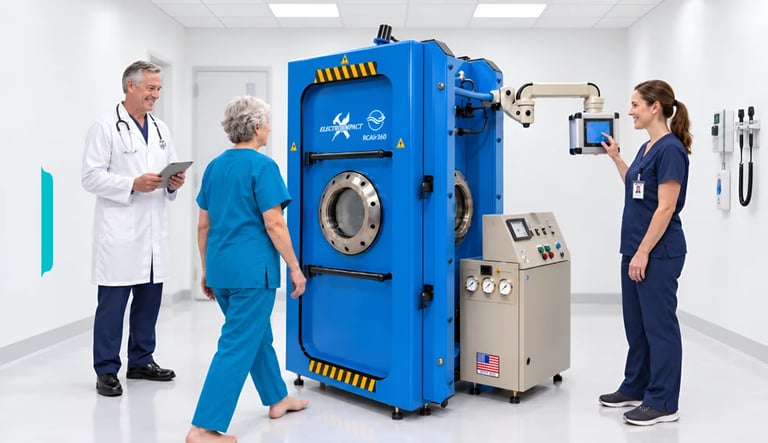
Office-placement concept | Approximately 100–120 sq. ft.
Hyperbaric oxygen therapy is delivered across a range of environments, but insurance reimbursement is generally associated with treatment provided within a clinical framework that meets established medical, documentation, and supervision requirements.
RxAir360 is designed to support physician-directed clinical delivery of HBOT, aligning with the operational structure typically required for reimbursement in outpatient medical settings.
This distinction is important when evaluating how hyperbaric therapy may be integrated into a practice.
Physicians evaluate HBOT integration based on patient volume and scheduling capacity
HBOT services are billed through established CPT and HCPCS billing codes and are reimbursable by Medicare and many commercial insurers for FDA-cleared indications. The table below illustrates gross revenue potential based on session volume.
| Utilization Level | Sessions / Day | Typical Practice Profile |
|---|---|---|
| Low | 3–4 | Part-time integration; single-condition focus; building referral volume |
| Moderate | 5–6 | Steady referral flow; multiple indications; established payer mix |
| High | 7–9 | Full schedule; dedicated HBOT coordinator; optimized payer mix |
| Utilization Level | Sessions / Day | Annual Sessions (48 wks × 5 days = 240 operating days) | Illustrative Gross Revenue Range Assumes $350–$550 per session blended rate |
|---|---|---|---|
| Low | 3–4 | 720–960 | $252,000–$528,000 |
| Moderate | 5–6 | 1,200–1,440 | $420,000–$792,000 |
| High | 7–9 | 1,680–2,160 | $588,000–$1,188,000 |
How These Numbers Are Built: The revenue ranges shown are total gross reimbursement — combining anticipated CPT 99183 supervision fees and G0277 facility reimbursement at assumed blended rates of $350–$550 per session. These are illustrative only and do not account for operating costs (oxygen, staffing, maintenance, insurance, facility overhead), which vary by practice and reduce realized margin. RxAir360 provides detailed financial modeling during the physician briefing process that accounts for the full cost structure of HBOT integration. Physicians should consult with their financial advisors and review their specific cost structure before projecting net revenue from any new clinical service.
| Code | Description | Notes |
|---|---|---|
| 99183 | Physician attendance and supervision of HBOT | Per session; rate varies by payer and region |
| G0277 | HBOT under pressure, full body chamber, per 30-minute interval | Varies by payer |
| E/M codes | Additional evaluation and management codes | Varies by indication and visit type |
Important Disclaimer: The CPT code information provided is for general educational purposes only. Reimbursement rates vary significantly by payer, geographic region, contract terms, and clinical indication. Rates are subject to annual updates by CMS and private payers. This information does not constitute a guarantee of reimbursement, practice revenue, or financial performance of any kind. Forward-looking financial projections involve risks and uncertainties, and actual results may differ materially. Physicians should verify all billing codes and rates with their billing team and payer contracts. RxAir360 is pre-revenue and the RxAir360 chamber is not yet cleared for sale or clinical use. Testing passed. FDA 510(k) submission next.
Note: The RxAir360 chamber is fully functional and has passed its testing. FDA 510(k) submission is next. The workflow described below represents the intended treatment protocol following regulatory clearance. The device is not yet cleared for sale or clinical use.
Footprint
10' × 12' — compatible with standard exam rooms
Power Requirements
Standard 220V outlet — no special electrical work required
Entryway Access
Vertical design allows for in-room positioning and patient access
Treatment Protocol
Sessions typically 60-90 minutes; staff training provided
Patient Evaluation
Physician assesses indication and determines treatment protocol
Session Preparation
Patient enters chamber; staff initiates compression protocol
Treatment Delivery
Automated monitoring throughout session; real-time safety systems active
Decompression & Follow-up
Gradual decompression; documentation and next session scheduling
Hyperbaric oxygen therapy chambers can be operated by trained clinical staff — physicians do not need to personally operate the system. Staff training pathways are available to support implementation.
Trained technicians or clinical staff can operate the chamber, allowing physicians to focus on patient care
Physician-directed protocols with trained clinical staff support during operations
Training programs exist to help staff develop the skills needed for hyperbaric operations
From initial inquiry to operational capability, here's the general process.
Submit consultation request; receive initial information
Discuss practice fit, space assessment, and clinical protocols
Space evaluation, electrical requirements, staff training schedule
Equipment delivery, setup, certification, and operational training
Staff certification requirements vary by state and facility type
Documentation and billing protocols align with existing EMR systems
NFPA-99 and PVHO-1 compliance requirements apply
Facility classification determines regulatory pathway
Reimbursement varies by payer and clinical indication
Prior authorization requirements depend on payer policies
Everything you need to know about billing and reimbursement for hyperbaric oxygen therapy.
Hyperbaric oxygen therapy (HBOT) may be covered by Medicare, Medicaid, and private insurers when used for specific indications recognized by CMS and supported by clinical guidelines.
Coverage is subject to:
Common covered indications include:
Coverage determinations are made by the payer and may vary.
Facility Services:
HBOT facility services are commonly billed under
HCPCS code G0277, typically in 30-minute
intervals.
Physician Supervision:
Physician supervision during treatment may be billed under
CPT 99183, generally one unit per treatment
session.
Coding and billing practices may vary based on payer requirements and clinical protocols.
Reimbursement for HBOT services varies based on:
A typical treatment session may include multiple units of G0277 (facility) and one unit of CPT 99183 (physician supervision).
Medicare reimbursement rates are established by CMS and updated annually.
Actual reimbursement amounts vary and should be evaluated based on individual practice and payer contracts.
Note: Practices typically evaluate reimbursement scenarios based on utilization, payer mix, and clinical indications.
Detailed reimbursement considerations are reviewed during physician consultations.
Documentation requirements generally include:
Standardized documentation processes are commonly used to support compliance and streamline clinical workflows.
Learn about the RxAir360 platform, clinical rationale, and development timeline — including what FDA clearance would mean for physician-office hyperbaric therapy. Testing passed. FDA 510(k) submission next.
Receive an overview of clinical integration considerations and current development status.